Bench Dip (knees bent)
Expert Advice
Keep your elbows pointed backwards and avoid shrugging your shoulders to maintain proper form and target the triceps effectively.
How-to-do Steps
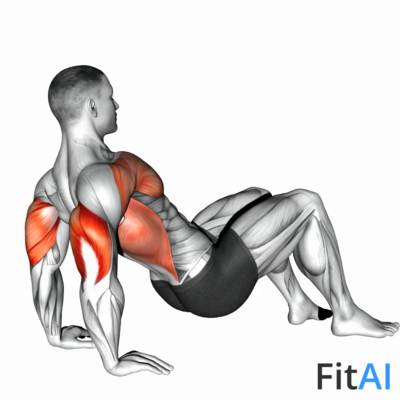
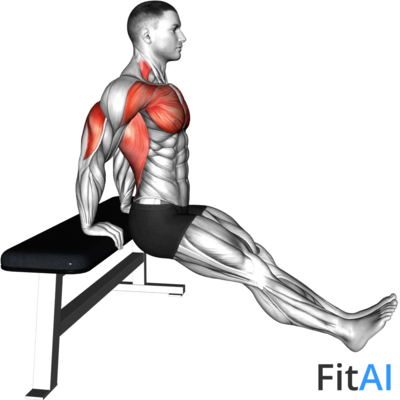
- Sit on the edge of a bench or chair with your hands next to your thighs.
- Move your feet forward and bend your knees at a 90-degree angle.
- Slide your buttocks off the bench, supporting your weight with your arms.
- Lower your body by bending your elbows until they reach a 90-degree angle.
- Push back up to the starting position by straightening your arms.
- Repeat for the desired number of repetitions.
Track Bench Dip (knees bent) in FitAI
Log your sets, reps, and weights automatically. Get AI-powered progressive overload recommendations and form feedback — personalized to your training history.
Muscles Worked
Bench Dip (knees bent) primarily targets the Triceps, with Strength mechanics using Body Weight. Understanding muscle activation patterns helps you focus on proper engagement and maximize training effectiveness.
Primary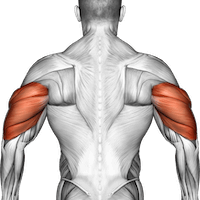
Triceps40%
Secondary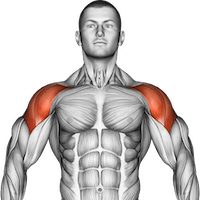
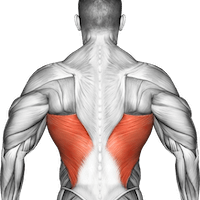
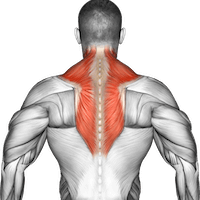
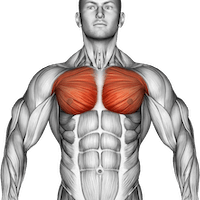
Shoulders20%
Lats20%
Traps10%
Chest10%
Equipment Body Weight
Exercise Type
Strength
Sets & Reps Guidance
Beginner3 x 12-15
Intermediate3 x 10-12
Advanced4 x 8-10
Frequently Asked Questions
What does Bench Dip (knees bent) work?
This exercise directly targets your triceps, with secondary activation in your shoulders, lats, traps, and chest. It is one of the most popular triceps exercises and requires no equipment at all.
Is Bench Dip (knees bent) good for beginners?
Yes. Bench Dip (knees bent) uses a simple movement pattern that does not require advanced coordination. It requires no equipment, so you can do it anywhere. Focus on controlled reps and good form before worrying about speed or volume.
How many sets and reps should I do for Bench Dip (knees bent)?
Start with 3 sets of 10 to 15 reps. If the exercise works one side at a time, do 10 to 15 reps per side. Rest 30 to 60 seconds between sets. Track your sets in the FitAI app to make sure you are progressing over time.